
ANCIENT ENGINEERING
How did Roman aqueducts work?
Roman aqueducts moved water using gravity and carefully planned routes. Here is how slopes, bridges and pressure pipes helped supply ancient cities.
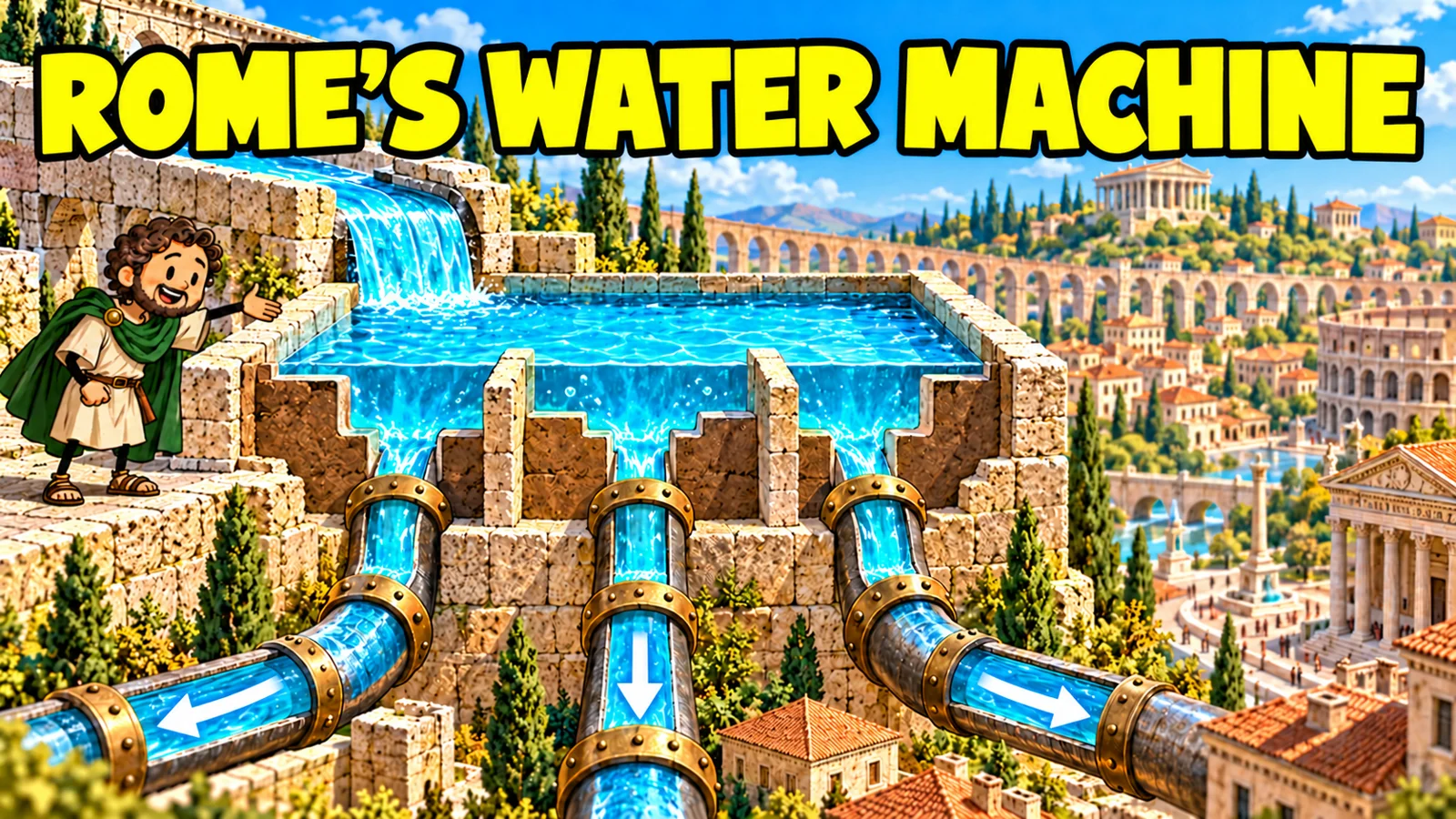
Roman aqueducts usually carried water along a gently descending channel. Gravity supplied the energy; engineers supplied the route. A bridge was only one part of a much larger system.
How did water travel without electric pumps?
A source above the destination gives water gravitational potential energy. In an open channel, a gradual downward slope allows water to keep moving toward the city. The challenge was to maintain a workable gradient across uneven ground.
Surveying mattered as much as masonry. A route could follow a hillside, pass through a tunnel or cross a valley on a bridge. The spectacular arches are the part we remember, but they supported a channel whose job was to preserve the planned elevation.
Did Roman aqueducts make water flow uphill?
Not without an energy source. Most open aqueduct channels ran downhill. In a closed pressure pipe, however, water can descend into a valley and rise on the other side. This arrangement is often called an inverted siphon.
The receiving end must be lower than the supply water level, with enough height difference to overcome friction and other losses. A rising section of pipe does not mean water is gaining energy: the system spends the pressure created by the higher source.
What does the Pont du Gard show us?
The Pont du Gard was part of the roughly 50-kilometre aqueduct supplying Nîmes. Its three tiers of arches carried the water channel across the Gardon valley. The monument makes the central engineering problem visible: keep the water route at the right level even when the land drops away.
Why an aqueduct is more than a bridge
Think of an aqueduct as a complete water route. Its performance depends on the source, gradient, channel, crossings and distribution system working together. An impressive bridge cannot compensate for a route that loses too much height before reaching its destination.
Watch the illustrated explanation
How Did Ancient Romans Make Water Flow Uphill? follows the engineering ideas behind Rome’s water systems.
Further reading
UNESCO: Pont du Gard (Roman Aqueduct) — the monument, its setting and its role in the Nîmes water supply.